Wednesday, 28 January 2015

a conversation with Glenn Buhr

Sam Decter

This evening the Thunder Bay Symphony Orchestra 
performs Glenn Buhr's Symphony number two (2001)
At Hilldale Lutheran Church, 321 Hilldale road, Thunder Bay, Ontario.
Please tell me a little about the performance history of your second symphony. 
Have you conducted it yourself? Which performance have you been most pleased with?


Glenn Buhr: 

The 2nd Symphony was written on commission 
from the CBC Vancouver Orchestra (now defunct). 
 It’s a tragic symphony, based on a song from my musical ‘Flux’, 
and I appropriated the stye of Baroque melodrama, to enhance the tragic element. 
 It was performed on Remembrance Day, exactly two months after 9/11. The music seemed to suit the time.  
The only other performance was with the Kitchener-Waterloo Symphony about eight years ago, 
but I’ve never conducted the work.

SD: 

How do you approach writing songs or airs for soloists 
such as Tracy Dahl or Sarah Slean
Do you write with specific performers in mind?

GB: 

 I always start with texts.  
The texts are in front of me, then I listen for music as I read them. 
 I’ve been writing songs since I was 14 years old.  
and music are closely linked; words have rhythm and pitch. 
 Prose and poetry are often musical when no music is present, 
so my job is to not lose the natural music in the words,
 but rather enhance it with my chords and melodies and counterpoint.  
I wrote my 3rd Symphony - a choral symphony - with Sarah Slean in mind.  
She’s a pop singer with a beautiful voice,
 and she’s musically literate too; a virtuoso classical pianist.  
Bramwell Tovey initiated the project with Tracy Dahl.  
They’ve done a lot of work together, so he brought us together for that project.

SD:

You've taught at Wilfred Laurier for 30 years now. 
How has your approach to teaching composition changed in three decades, 
and how has being part of the Kitchener-Waterloo music scene 
affected your approach to/outlook on music?

GB: 

My teaching has changed as the culture has changed.  
I opened up a program in improvisation and creative performance 
about 15 years ago in reaction the the dwindling interest in new concert music.  

 Concert music is just another of several genres. 
 It’s narrow-minded to expect important new work 
to only emerge form a musical class system that peaked in the 19th century,


 so we need to evolve our pedagogy as the world turns.

Creative music makers are at a disadvantage if they ...wait for the phone to ring 
hoping that some classical virtuoso might want to perform their work.  
Jazz and rock musicians perform their own music.  
Their audiences expect that. 

 There’s no reason to limit that idea to jazz and rock.  
New genres are always forming, 
and that depends mostly on what is going on in our culture, 
which is always changing. 

SD: 

As one of its founders, 
what are your thoughts on the current direction 
of the WSO New Music Festival?

GB: 

I’m rarely able to go to the festival these days.  
 I’m pleased that it still seems to be going strong, and that the public is still engaged.  
The various teams have done a good job with the programming, 
but the giddy days of the early years of the festival are gone.  

Back then, we had no idea that the festival was going to be as popular as it became.  
That lovely shock kept the energy and innovation going for quite a few years.

SD: 

What was your experience like 
as composer-in-residence with the WSO?

GB: 

That was a wonderful time. 
 Bramwell Tovey was very supportive of my work, 
and he still conducts some of the music I wrote for the WSO 
with the various orchestras that he's working with now. 
 In those days, he didn’t know too much about contemporary music, 
so it was my job to do all of the programming and stage design for the festival.  
And I love producing innovative concerts and also writing music, so it was my dream job.

SD: 

What was the inspiration behind the 
Music in the Ruins project?

GB: 

 Margaret (my wifenovelist Margaret Sweatman
and I moved into the residence at the Ruins of the Trappist Monastery 
in St. Norbert to escape our flooded property.  

(The Ruins are on the right side 
of the Red River Floodway; 
our house was on the wrong side, 
and was immersed.)  

So we partnered with the St. Norbert Arts Centre to create a musical version 
of what they were already doing with theatreShakespeare in the Ruins.   

That was the first time that I’d ever produced a musical event separate from the WSO.  
I now put together about 5 or 6 different productions every year, 
some of which have a longer lifelike my new band, The Button Factory Band.

SD:

 Did you play a part in organizing the 
Contemporary jazz summit in 2012?

GB: 

I produced that when I was Artistic Director 
with NUMUS Concerts in Kitchener-Waterloo.  
It focused on new work, 
and also the music of Miles Davis 
and Thelonious Monk.


SD: 

Which Jazz musicians have had the most influence 
on you as a piano player? 

GB: 

Bill Evans, Keith Jarrett, Thelonious Monk, 
Chick Corea, John Lewis, Oscar Peterson

SD:

As a songwriter?

GB: 

Neil Young, Tom Waits, Joni Mitchell, Leonard Cohen, 
Bob Dylan, John Lennon, David Byrne, 
Paul Simon, Daniel Lanois

SD:

 Do you see Jazz as Black 
America's Classical music?

GB:  

Yes, since like classical European music, 
Jazz is essentially a dead language 
that lives on in other forms of social music. 
 We preserve jazz like we preserve the classical music of Old Europe. 
 The museums are concert halls, educational institutions, 
libraries, music notation and tribute concerts. 

 (W)e have a lot of new music evolving 
that includes some sounds and attitudes of the old music, 
but it’s a new and present language.  
I see the Hip hop culture as a new incarnation of Jazz.  
The  syncopated words (often improvised) of Hip hop  
have replaced the syncopated melodies (often improvised) of Jazz. 

 Both emerged from African American culture 
which is a living and thriving musical culture, 
...the language of the music is always changing.  
I’m with Miles Davis on this. 
 He stopped using the word ‘Jazz’, 
and replaced that with ‘Social Music’ 
in his vocabulary.

SD:  

What is the Ebony Tower?

GB: 

It’s a short story by John Fowles
 about a young avant-garde artist 
interviewing an older and very successful painter 
who is opinionated in the extreme.  
For the older painter, the new style is too antiseptic, 
and a negative new direction, 
hence ‘The Ebony Tower’. 

I like the term as an analogue 
for the art that emigrant African culture has given us, 
especially through music.  
So it’s the title of a complex set of variations that I wrote in 1984, 
based on a blues song of mine 
that was more influenced by African-American music 
than by Western classical music. 
 It’s interesting that most conventional jazz 
is an appropriation of variation technique that was developed in Old Europe.  
The influences go both ways.


SD: 

Vis: your thesis in Our Native Song: "all music is folk music." 
Does this idea stand up to the influence of capitalism and marketing 
on how music is commodified, 
homogenized, and electronically consumed?

GB: 

All music is folk music simply because it’s made for and by people.  
I really needed to articulate this because there is a pervasive idea out there 
that classical music is  superior to just about every other music.  
But it’s not superior, it’s just different than many other kinds of music 
because the social strata from which it emerged is different.  

The toe-hold on the idea of its ‘superiority’ 
comes from the drive of the European Empire to conquer the world.  
I guess those kings, emperors and dictators thought 
that if they could take Africa, India, and the New World, 
then their music must be better. 
 But really, it’s just music 
that the literate classes enjoyed ... 
so it’s folk music.  
The folks just happened to be also independently wealthy.  
Rich folk are still folk.

Music has been commodified since before I was born. I’m used to it, 
and I can still here a strong cultural voice in most music, even these days.  
Commercialism has always muddied the cultural quality of music to some degree.  
But culture is messy and organic, like soil and fertilizer 
That kind of muck often generates new and unusual things.  

SD: 

I too am a musical Winnipeg ex-pat. 
I recall Winnipeg as a place of plains, trains, and all-ages punk shows. 
How do you feel Winnipeg has defined who you are and what you do?

GB: 

Well, I’m still a Winnipegger.  I have a house there, 
and Margaret teaches creative writing at the University of Winnipeg, 
so I still haunt the place. One of my favourite artists/activists/philosophers is Neil Young.  
We both grew up in Winnipeg, and I think that Winnipeg punk/funk is there in his music, and also in mine.  
It's a great city, with a sharply drawn musical personality.  

SD: 

Has Winnipeg changed since you grew up there?

GB: 

I hopped a train near Higgins and Main when I was 17 years old 
and headed out to the west coast for some adventure. 
 Now, there’s a music club there on Main Street the Times Change(d) 
and you can watch a good band in the summer and look past them, 
out the window over Main Street to the rail lines. 
 The trains are still heading west. 
  
The First Nations folks have finally found a foothold, 
and have a healthy influence on the culture. 
 But other than that, it’s still trains, 
plains and all-ages punk.  
Eternal and utopic.


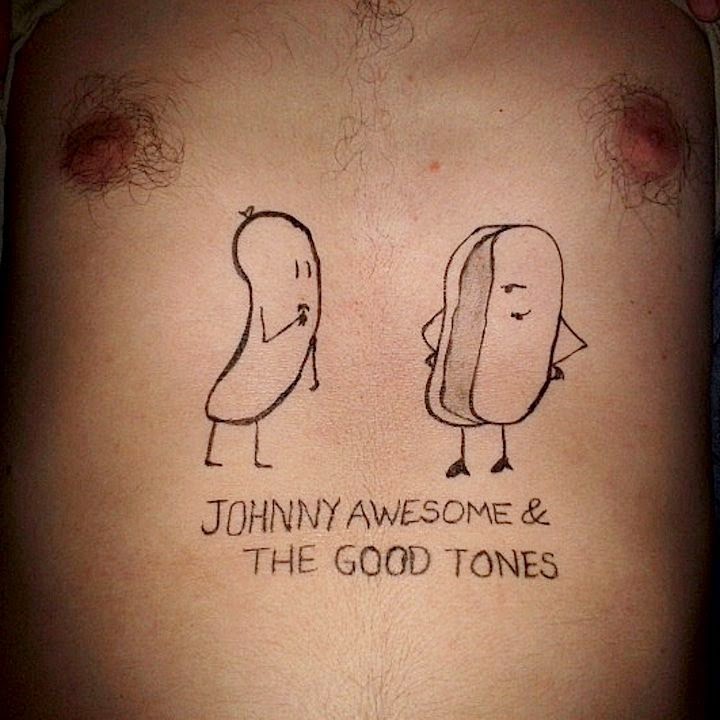
Tales of Johnny Awesome


I have crossed paths with this modern-day minstrel once or twice in the course of my Parkdale peregrinations. Often the uninitiated will inquire: Who is this Johnny, and what makes him so awesome? 
Hearsay and rumour swirls round the man, so I'll stick to my firsthand experiences.
I auditioned for the drum chair in a precursor to the GOODTONES band, 
and was turned away not simply for my lack of experience, 
but for my methods of learning and communicating about music. 
You see, JA is a different kind of dude. 
He doesn't say:  -This song is in 4/4 with a little funk in the kick drum pattern. 
He says: -The drums in the verse are green, and the chorus is purple with splashes of yellow. 
Ever the producer, and most likely a synaesthete, he snagged Dawn Lewis from TINA SUNSHINE, 
who could get on this vibe, and I went back to Not My Dog to play half-kit on jam nights, 
practiced using all four limbs to make beats, while imagining what colors JA might say the music had. Awesome?


One time JA got me out of jail. 
His bassist and I were despondantly besotted (read: drunk on vodka) 
following BRIGITTE's farewell performance at a College st house party, 
and in the course of our aimless exit ran afoul of the weekend last call College st rush hour. 
The authorities soon arrived, our belligerence earning us a night's incarceration, 
and a potential moving traffic violation. 
I could swear we were just two inebriates with a boombox running low on batteries, 
but the TPS defined us as a threat to the orderly function of streetcars and taxicabs. 
I raved and ranted through my captivity, while the bass-man sat on his stash. 
JA quickly got wind of our predicament via Stacey Kitanya, then front(wo)man of the DUST BUNNIES. 
His timely call to the division night-desk Sergeant shrewdly elicited such information his sharp legal mind required to put drunk-tank-sized holes in our pending charges, 
and effect our release immediately upon shift change the next morning. 
He brought us beer and entreated us to behave. 
Awesome!


A couple years later, I shared a rehearsal space with 
MOOSEBLOOD, WE ARE FRENCH, and the GOODTONES.
Arriving at the space one night, seeking solace with the mice and empties, 
I found JA had already laid claim to the room's only couch. It was then and there decided that we would find an apartment together and establish a home studio/ bohemian refuge, like Gaugin and Van Gogh.
 I won the coin toss and first dibs on the larger, more seductive of the two bedrooms, 
and our living room became a place of socio-musical experiments, looped traffic sounds and Stravinsky collages. Every morning we would smoke on our back porch, 
discussing the vicissitudes of the food and beverage industry, 
and defend our growing stash of empties from the fearless local squirrels.
 -One day, he told me -we will return these beer and liquor bottles, and we will have riches for a great feast. 
He didn't always say much, but he was always thinking big.

(EL Florendo)


Then we went on tour in the Steam whistle keg delivery van, 
with RETRO RADIO and a few other bands whose names and sounds I have long since repressed. 
From the kick-off at the Garrison, to Sarnia, Windsor, and London, 
we persevered like seasoned road warriors, offering our last half-tab to all the merry pranksters in our party.
 It was not until returning to the safety of our own apartment 
that the trauma of the touring lifestyle took its toll on our fragile egos.

A fire was set, the ritual began. 
A flat of beer scored from the van fueled the strange 
and highly toxic melting of all available talismans of our indentured servitude 
and the senseless dating scene to which we had returned from the horrible freedom of the touring life. 
As noxious fumes loomed in our kitchen, we turned a video camera towards our polyphenol crucible, 
nodding in silent agreement that one day we would be able to look back 
on this act of transcendental arson with some kind of nostalgic perspective. 
As we melted yet another compact disc, and burned the last of our respective love letters, 
JA coughed, breaking the hallucinatory silence.

-I don't think it's a good thing for us to live together anymore.

If these tales are insufficient to assure you of JA's legendary status, 
go see the man himself at the TO Lounge this Friday night.
 Awesome.


Monday, 26 January 2015

Ears and Eyes Presents: Vinyl Listening Party - this Friday @ cafe Natura


  • The tinderbox sat down with Shane Erikson, aka DJ Seith,
    the man behind the Vinyl Listening Parties, to talk turkey and get funked.

    • Sam Decter
      Sam Decter

       
      Let's start with when did the listening parties first start and who runs them?


  • Shane Erickson
    Shane Erikson


    I first had the idea back in May of 2014 at a Youth Social Infrastructure camping retreat during a World Cafe where I got to sit down with Lisa Hollingshead and talk about the music scene in Northern Ontario at length. The idea gestated from that talk and sat on the backburner until early September when I was speaking with Jessica Bolduc of Ears And Eyes and we worked together to make the first one happen at Cafe Natura on Elgin St. The parties are run by Ears And Eyes with promotional help from The Rad Zone.
  • Sam Decter
    Sam


    Why do you believe the medium of vinyl to be so important?

  • Shane Erickson
    Shane


    It is the medium of music delivery with the longest track-record in the history of mankind, second only to playing music live. But why do I personally find it important? As a turntablist DJ, I love the feel of manipulating wax under a needle to create cool sounds. There is really no substitute for that feeling of working to mix music in such an immediately understandable way. As a listener and collector, I really enjoy going to a record store and spending time rooting around in their wares for something that catches my ear. I primarily look for oldschool hip-hop, funk, soul, jazz, afro-latin, anything with a funky drum to it. That or very quirky electronic sounds, those make for lots of fun to scratch with. And when I find a good record, there is a rush to that. I'm all for listening to and mixing music in any form, digitally or otherwise, but I put vinyl above all the others, for sure.

  • Sam Decter
    Sam


    Word. So how do the events aim to share the experience of vinyl?
  • Shane Erickson
    Shane


    The events are designed to provide a warm, inviting atmosphere for people to get together and enjoy the vinyl-listening experience in a social setting. For collectors, it is a chance to share some stories of collecting and/or music history with others, as well as bring out interesting pieces of vinyl and play them to a crowd, and for non-collectors, the event can act as a "gateway" into new styles of music that they may not have heard before, and it can also act as a starting point for would-be collectors, as we have a crate of hand-picked vinyl at every party, with reduced party-only prices courtesy of Paul and the gang at The Rad Zone.
  • Shane Erickson
    Shane

    We even have a draw every month for a 25$ gift certificate to The Rad Zone, 
    good for use on any used vinyl in the store.
    We also support local art and music at the merch table.


  • Sam Decter

    Sam

    It's a really neat community activity. Do you feel that the ease and scope of what's available digitally has robbed people of the opportunity to DJ together?

  • Shane EricksonShane


    I would say it has changed the way we share music. It is much easier to share music with others and start dialogue about music online, but that has given way to a listener's need for the personal element. Part of the appeal of the vinyl listening party comes from exactly that; people in a cafe listening to records. It brings the romance back to listening to music in a way online interactions never could.
  • Sam Decter

    Sam

    It's a little daunting to think of the great progress we've seen in our lifetime as far as access and sharing goes. It's almost as though we never missed the romance of the communal listening experience until it began to disappear

  • Shane Erickson
    Shane Erikson


    Joni Mitchell never lied.


Friday, 16 January 2015

SMAC Fest 2015/SHIFTERS artist profiles part two: Luke Grandmount and Michael Burtch

 LUKE GRANDMOUNT

 b. Sault Ste Marie,1983 
Studied English at Laurentian University/Algoma U campus 
graduated with Bachelor of Arts (honours) in 2006
went to Thunder Bay in 2007 to study Film Production,
graduating from Confederation College in 2009.
From 2010 - 2013 worked at a camera equipment manufacturing company (Cinevate) in marketing, creating instructional videos and going to trade-shows.
December 2013 left that job to go back to freelancing and have the freedom to re-focus on storytelling and creating films

Tinderbox:

Hodid you get involved in SMAC Fest? 
Grandmount:

I'm a founding member of an arts collective in Thunder Bay (North Light Media Colelctive) that benefitted from the same Ontario Arts Council funding that got SMAC its start, so I've been following the group's progress since they started it. I'm thrilled to be able to take part in the event now that I'm back home (more or less). 

 Tell me about the film you'll be showing this weekend.

I've been pretty fortunate so far with this film and the festivals it has been accepted into. It has shown
in film festivals in Canada, the United States, and overseas in Scotland and Romania, but I wasn't yet able to screen it back home - until now.
The Last Straw is a hybrid live-action and animation short film set on a farm in Northern Ontario. The film combines live action elements with puppeteering and digital animation. The short received CTV Best in Shorts Best Animation award in the 2013.

What's the film about?
 
Scarecrow stands guard with his only friend, a crotchety old crow, perched at his shoulder. The unlikely duo are in breach of Scarecrow’s duty to protect the field, and their friendship hasn’t gone unnoticed by The Farmer. With his crop at risk, The Farmer erects a newer and much scarier scarecrow to ward off crows. Fearing forced retirement, Scarecrow takes matters into his own hands to deal with the new threat. Will Scarecrow find common ground with the new guy or will this be the last straw?

What projects are you currently working on?

I'm currently in post-production on my next short film, The Maltese Guinea Pig. This will be completed in the coming months and I'm hoping to find success in the film festival circuit again. Although modestly budgeted, I was able to get some funding via crowdsourcing online with Indiegogo (https://www.indiegogo.com/projects/the-maltese-guinea-pig)

MICHAEL BURTCH

Retired Curator/Director of the Art Gallery of Algoma,
Research Associate with Nordik Institute at Algoma University
Sculptor and Sound Artist
Solo exhibition May-July 2012 at the Art Gallery of Algoma
Extensive exhibition history
Allied Arts award-winning Sault Waterfront Sound Sculpture:


Burtch has published articles and catalogues on artists including:
J. Barry
David Bierk
Ken Danby
John Howlin
Curatorial Essay in the Art Gallery of Algoma’s “One hundred years of art in the Sault”
Author of ‘Hymn to the Sun’, a book on the subject of artist Jack Bush’s early work,
which accompanied a national tour of the artist’s work.

Currently involved in a major research project w/ Gary and Joanie McGuffin,
a film on the Group of Seven; produced by White Pine Pictures, to be released by TVO

 Artist Statement:

My work revolves around the concept of the human body as an extension of consciousness,
consciousness as an extended, infinite field,
 consciousness as the generative force of all being.
The implicit interweaving of mind, matter, spirit, body, and consciousness
informs existence and permeates our experience of being in the world.
Replication, entropy, the mirror image and light as a metaphor for consciousness underscore my visual and my sonic explorations.
I am fascinated by the primal aspects of physical gesture as archetypal symbol,
simultaneously personal yet universal.
In many ways the sculpted bodies are topographical entities, landscapes,
blurring the distinction between nature and culture, male and female, self and other.


from the artist's website:

Throughout human history, 
the body has been the most resonant yet enigmatic symbol of our innermost being.
 It evokes fear, awe, pathos, the knowledge of mortality and our search for immortality, sexuality, sensuality and all the complex layers of meaning that lie between. 
Our fascination with the representation of the human figure 
is rooted in its ability to hold a mirror to our shifting, fragmented notions of self.
 It offers an elusive and unstable connection

 between the primal self and the public persona.


In spite of, or perhaps because of, 

the difficulty in locating the figures' precise significance 
in our dedicated understanding of existence, 
the figure still holds, and will always hold, its obsessive power.

My work is a continuing search for the physical signs of our spiritual state. 

The nude is both a timeless and time bound vehicle for that search.


details and full view of "Bodies in Motion"


Wednesday, 14 January 2015

SMAC fest 2015 preview + artist profiles part one: Christopher Shoust/Angelline Castilloux

Inside a repurposed warehouse near the corner of Gore street and Wellington,
strange things are transpiring.
Behind a black curtained-off window,
various images are being projected onto a nude statue.
Michael Burtch, creator of this component of the installation,
mans the projector with a good-natured grin.
Unidentified seeds, perhaps from an elm tree,
gather and disappear in small piles in another corner of the gallery space.
 Miranda Bouchard, Curator of the SMAC fest filmscreening
and of the SHIFTERS exhibition,
watches over the various goings-on with a calm, patient gaze.
Andrea Pinheiro; Director/owner of 180 projects,
knocks holes in walls, orders vast amounts of popcorn, 
and prepares for this weekend's upcoming exhibition/film screening.


 Why Media Arts? Because like any other field,
be it education, business, or entertainment.
those working in the arts must maintain awareness and familiarity 
with the technologies available to them.
Because the roles of filmmaker and music producer have
been wrenched from the hands of elitist corporate studios
and are now within reach of anyone with access to a laptop and a
cameraphone.

The Filmmakers:

CHRISTOPHER SHOUST

Born in the Sault in 1982, an artist and writer from an early age,
Shoust pursued both these practices throughout his youth.
While attending journalism school in Windsor, he started to get serious about painting,
and worked in radio for a couple years.
He began writing his first novel, THE BEGGAR
(published by Black Rose Writing), upon returning to the Sault for a newspaper job.
Shoust moved to Victoria to escape the recession and pursue his work in the arts
There he began his career as an artist and continued to write seriously.
                              18 months later he moved to Saskatchewan to write for two local papers.
There, he continued painting and soon graduated with a BFA back in the Soo.
 His writing ranges from fiction to non fiction, from new journalism to dream journaling.
Victoria to Vancouver is a super 8 film, and winner of the Rising Star award at the 2013
Canadian International Independant Film Festival in Vancouver.

Shoust:
‘Victoria to Vancouver’ was shot over three days in the summer of 2004.
I tried to compact the three days into three minutes of film,
(using) the super 8 camera more as a still camera than for motion picture.
I made single shots to try to represent memory,
when a person reflects on a voyage and all the images of those
events flutter back to them.
This film was produced in 2007 as a silent film, but took on a new identity
in 2012 with the help of Stephen Lang

Tinderbox:
 What role does film play in your work? What does the medium offer you that your other pursuits cannot?

It fills the holes between painting and music. It's that simple.

And how did this collaboration with Stephen Lang come about?

For this film it was like Steve knew what the perfect music would be in my mind. 
It really helps to fuse the video with the audio like you are daydreaming.

Sounds like a very organic process. Have you two worked together before?

This was our first project. He later edited America dreamt for me.

What changes did this piece undergo in between being who in 2004 and its 2013 award-winning screening?

Not much. I had a musician that did a lot of talking from Victoria but did nothing. It wasn't until I gave the only two reels shot to Steve that things started to happen.

Shoust has produced four works as filmmaker:
Victoria to Vancouver (2012)
Skate Renegade (2013)
Vortex (2013)
America Dreamt (2014)

ANGELINE CASTILLOUX


A fine arts student at Algoma U,
Castilloux’ SMAC Fest offering focuses on one of the
Residential Schools that existed in her hometown of Chapeleau.

Castilloux: 

  My work is a short video focusing on a Residential School which was in operation from 1907-1921 just across the river from where I grew up, in Chapleau Ontario.  More than 20 children died there and no one knows where their graves are, as the site was abandoned in 1921 after a new school was built a few km away. The school was called the Chapleau Indian Boarding School.

What motivated you to make this particular film?

Well, I'm a student at Algoma U, which is the former Shingwauk Residential school.  While learning about Shingwauk and looking at the archives I decided to search for information about the Chapleau school.  I had always known about the school located just outside of town, but I didn't realize there had been in fact, two.  I decided to focus on the first school built because there didn't seem to be much information known about it and the students who attended.

Is film a new medium for you? 

Yes, film is a new media for me.  The video was originally filmed as a supplement to a class assignment. My film was an accompaniment to a blog I have detailing my research and discoveries about the school. The entire project was done for a class in which we looked at how archives and art were connected. 

How did you end up studying fine arts at Algoma?

I ended up at Algoma U by chance; I had always wanted to study Fine Arts but there were no places to do that where I lived.  I finally had the opportunity when I moved to SSM.
 
 detail from installation by Michael Burtch

Indeed, the stated goal of the 360 Collective to empower, educate, and equip new media artists
With the means to conceive realise, and show their work seems to be gaining steam.
This festival is not only a place for Northern Ontario artists to showcase their work;
it is a motivation for artists who may not identify as filmmakers,
or even have a clear understanding of what it means to be a media artist.